Javascript Menu by Deluxe-Menu.com
px

This text is replaced by the Flash movie.
Air Displacement Technology

The most advanced technique for assessing body composition available today

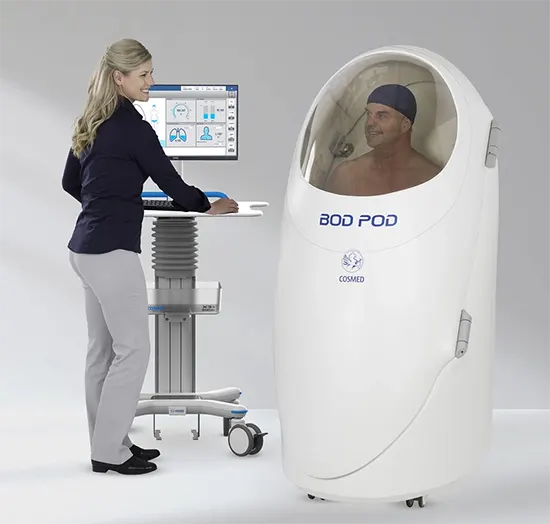
The patented air displacement technology used by the BOD POD and PEA POD is similar in principle to hydrostatic (or "underwater") weighing. The obvious difference is that air is more convenient and comfortable than water, so that Air Displacement Technology provides a much easier and safer testing environment, better reliability, and significantly improved repeatability and accuracy.

The basic operating principles of air displacement technology include Densitometry, Mass Measurement, Volume Measurement, Thoracic Gas Volume, and Surface Area Artifact.

Densitometry

With Air Displacement Technology, body composition is derived from body density, or Densitometry. In densitometry, the more dense a body is, the lower the percentage of body fat; the less dense a body is, the higher the percentage of body fat.

Density = Mass/Volume

Densitometry is based on modeling the body into two compartments: a fat compartment and a fat-free mass compartment. The fat-free mass compartment consists of protein, water, mineral, and glycogen.

Chart: BodyComp ADP 1

From the subject's body density, relative proportions of body fat and lean body mass are calculated based on the density of fat and lean tissue. Because lean tissue is more dense than fat tissue, a higher density reflects a higher proportion of lean tissue.

A commonly used equation which translates whole body density to percent body fat is the Siri equation:

Percent Fat = [495/Density] - 450

Once the percent body fat is calculated, the percent lean body mass can also be determined as follows:

Percent Lean Body Mass = 100 - Percent Fat

Mass Measurement

Mass (weight) is measured using a very precise, integrated electronic scale.

Volume Measurement

Volume is determined by Air Displacement Plethysmography (ADP), which occurs when the subject is inside the BOD POD or PEA POD chamber. ADP relies on the relationship between pressure and volume, and allows for the derivation of an unknown volume by directly measuring pressure.

During the volume measurement, small changes in volume occur inside the chamber, and the pressure response to these small volume changes is measured. This is done by measuring the interior volume of the empty chamber, then measuring it again when the subject is inside. By subtraction, the subject's body volume is obtained. For example, the interior air volume of the empty chamber is 450 liters; so if the volume of the chamber is reduced to 350 liters with the subject inside, the body volume of the subject would be 50 liters.

Thoracic Gas Volume

Because any air trapped in the subject's thoracic cavity, either free or trapped, is not part of their body volume, the air in the lungs must be accounted for. Depending upon the capabilities of the device being used, Thoracic Gas Volume may be directly measured, retrieved from a previous test, predicted (using a standard prediction equation), or entered manually.

Surface Area Artifact

Due to isothermal behavior, the volume of air in close proximity of the subject's surface is overestimated by 40%. This small Surface Area Artifact (an apparent reduction in the subject’s body volume) is automatically calculated by the BOD POD and used to correct subject body volume.

The surface area of clothing and hair can also have a significant impact on Volume measurements. It is extremely important that subjects tested using Air Displacement Technology wear minimal, form-fitting clothing and a cap to compress the hair on the head.

px